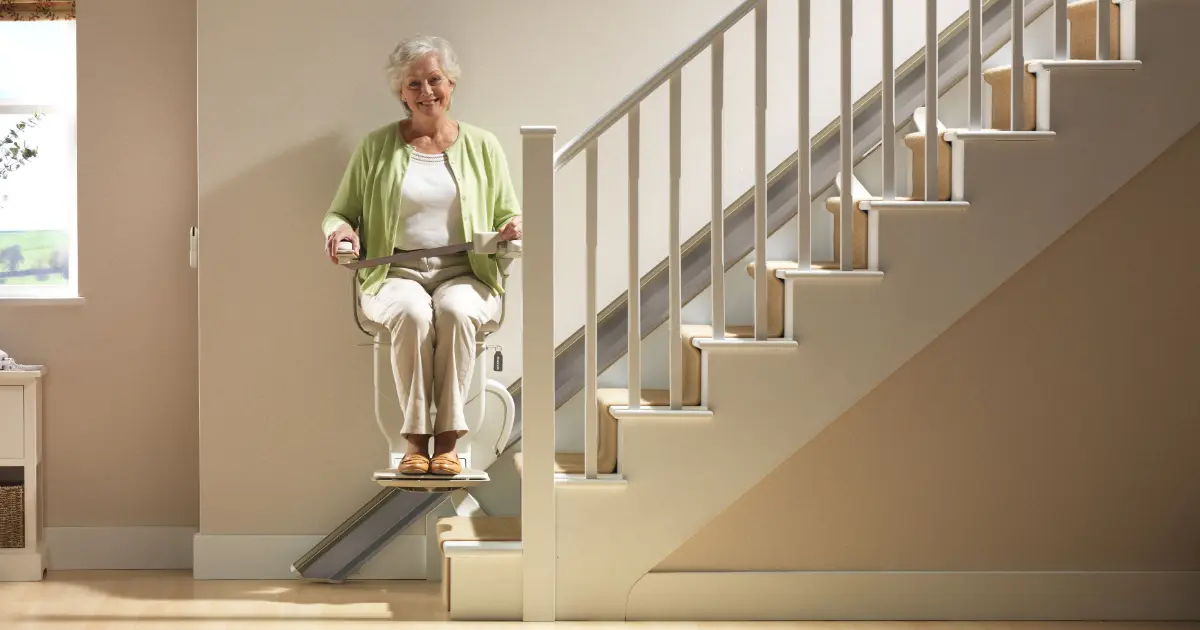
Safe In Place helps families evaluate the rider, staircase, and practical options, then connects them with an appropriate local stair-lift professional in Miami-Dade, Broward, or Palm Beach County.
The right stair lift must fit both the staircase and the person who will use it.
How Safe In Place helps
From a difficult staircase to a clear next step
You do not need to choose a model before reaching out. Start with what has become difficult and how the stairs are configured.
1
Tell us what is happening
Share who will use the lift, the staircase shape, whether it is indoors or outdoors, and how soon help is needed.
2
We help assess the situation
We consider transfer ability, rider needs, staircase geometry, landing space, and whether another access solution should also be compared.
3
We connect you with local help
We identify an appropriate professional whose products, service area, and capabilities fit the situation.
4
The professional measures and quotes
The selected provider confirms the model, rail, options, installation scope, price, warranty, and service plan with you.
Start with the rider
Is a stair lift the right solution?
A stair lift carries a person in a seat. The rider must be able to transfer onto the chair—with appropriate help when needed—remain safely positioned, and transfer again at the destination landing.
A stair lift may fit when
The rider can transfer onto and off the seat safely
They can remain seated and use the restraint during travel
They can operate the control or have suitable caregiver support
There is adequate space to approach and transfer at both landings
Compare another solution when
The rider must remain in a wheelchair during travel
Transfers are unsafe or likely to become impractical soon
A mobility device cannot be available where it is needed on both floors
A vertical platform lift, home elevator, or one-floor living may better match the long-term need
This is a functional home-access decision, not a medical diagnosis. A good assessment looks beyond today’s staircase to how the person will use the home.
Measure more than stair width
What determines whether a stair lift will fit?
There is no single minimum width or universal model. The full survey must account for the rail, folded chair, rider clearance, doors, landings, and safe transfers.
Staircase geometry
Length, pitch, width, bends, landings, and whether the rail runs on the left or right determine the basic system.
Doors and walkways
A rail can conflict with a doorway or hall at the bottom. A hinged or folding rail may solve the conflict on compatible models.
Rider dimensions and transfer
Weight capacity, seat size, knee and foot clearance, preferred transfer direction, and balance all affect model selection.
Usable stair space
Folded depth matters, but so does the rider’s occupied position. The stairs must remain practical for other household members.
Top and bottom landings
A swivel seat, rail overrun, parked position, and clear level space can make transfers safer and keep the chair out of the way.
Caregiver and mobility-device needs
The plan should consider remote call/send controls and whether a walker or wheelchair is needed on both floors.
The staircase sets the rail
Straight, curved, and outdoor stair lifts
The rail configuration is the biggest product distinction. Features and upholstery come later; the first question is how the lift must travel through the home.
Straight stair lifts
Where it may fit
A single, uninterrupted flight without turns or intermediate landings. The rail is standardized and cut to the measured length.
What to consider
Doors, narrow hallways, and top or bottom clearance can still require a hinged rail, overrun, or other option.
Curved stair lifts
Where it may fit
Staircases with bends, spiral sections, multiple flights, or a landing that the rider needs to travel through without changing chairs.
What to consider
The rail is measured and custom-made for the staircase, which adds fabrication time and makes the system substantially more expensive.
Outdoor stair lifts
Where it may fit
Exterior porch, patio, or garden steps when a chair lift—not a wheelchair platform—is appropriate for the rider.
What to consider
Use a model specifically rated for the location. Exposure, protected charging, covers, maintenance, and warranty conditions all matter.
What about a perch or semi-standing seat?
Most stair lifts are seated. Selected models offer a perch or semi-standing position for people who have difficulty bending their hips or knees. Suitability still depends on secure positioning, clearance, and the individual assessment.
Features with a purpose
Safety, transfer, and space-saving options
The useful options are the ones that solve a measured problem. Ask the provider to demonstrate every control and safety feature with the rider and caregiver present.
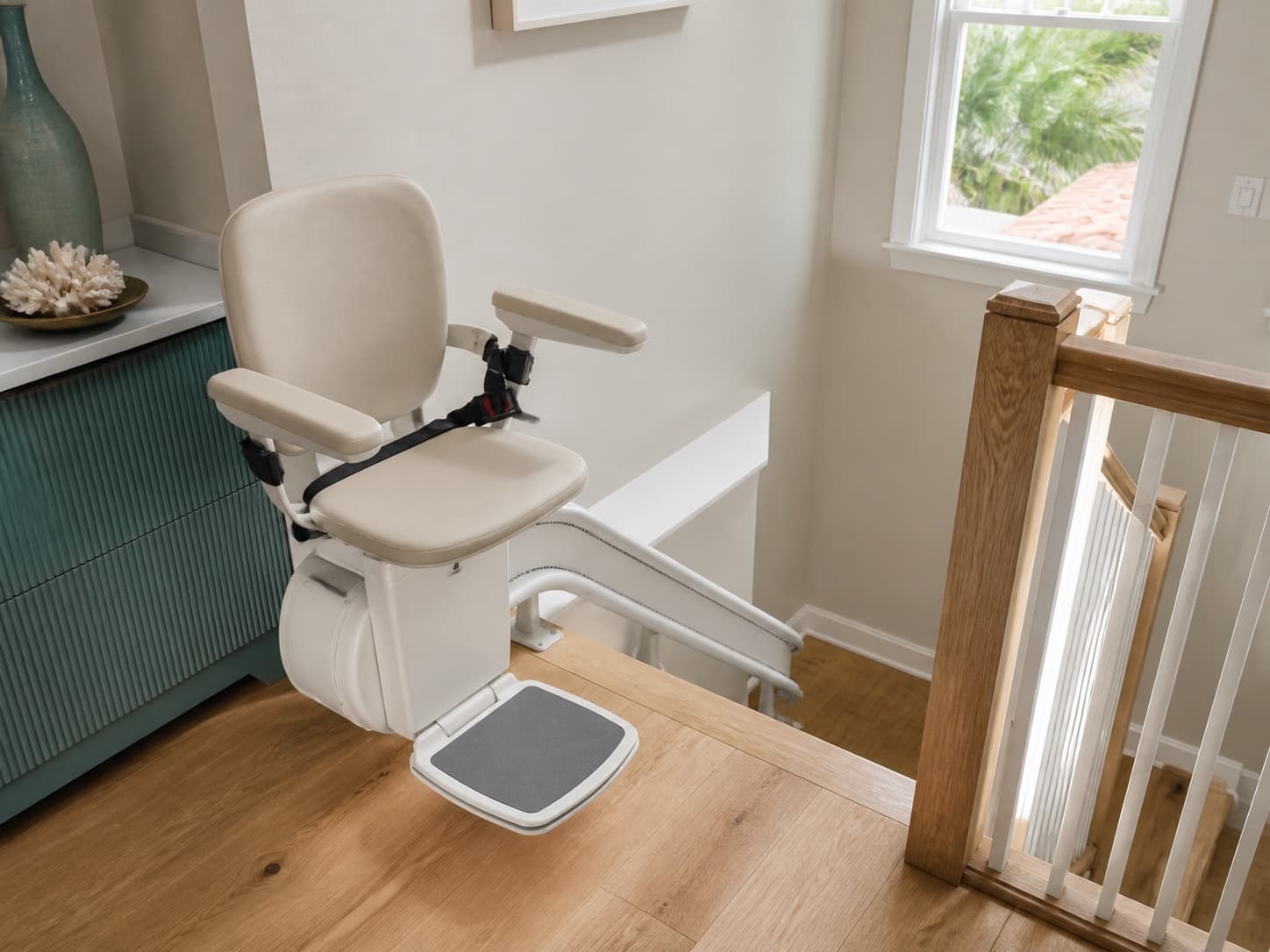
At the upper landing, a swivel seat can face the rider away from the open stair flight for transfer.
Seat belt and sensors
A restraint, obstruction sensors, braking systems, and constant-pressure controls are common safeguards; exact features vary by model.
Swivel seat
Manual or powered swivel can help the rider transfer toward the landing instead of the open staircase. Interlocks should prevent travel in the wrong position.
Battery operation
Many lifts recharge from household power and can make limited trips during an outage when charged. Trip count varies by model, battery condition, load, and staircase.
Call/send controls
Remote controls let someone call the empty chair to another floor or send it out of the way when the model supports it.
Powered options
A powered footrest or swivel can be an important functional aid when bending or turning the seat manually is difficult.
Folding or hinged components
Fold-up seats, arms, footrests, and compatible folding rails can preserve walkway and stair access when the lift is parked.
What installation involves
Measurement, rail preparation, installation, and training
Many rails attach to the stair treads rather than the wall. That often avoids wall reinforcement, but brackets still create mounting points on the staircase.
01
Home and rider survey
The provider measures the stairs and landings, checks power, confirms transfer space, and documents the rider’s needs.
02
System specification
The quote identifies the exact model, rail side and length, options, capacity, installation scope, warranty, and service responsibility.
03
Rail preparation
Straight rails may be prepared from standard sections. Curved rails require staircase-specific design and fabrication before the site visit.
04
Installation and instruction
The professional mounts, tests, and commissions the lift, then teaches the rider and caregiver how to operate, charge, fold, swivel, and stop it.
Onsite work and total lead time are different
A straight lift can often be installed onsite within a day once the correct equipment is ready. A custom curved system takes longer overall because its rail must first be measured, designed, and fabricated. Ask for both dates in writing.
Choose the access method first
Stair lift vs. platform lift or home elevator
A seated stair lift may fit when
The rider can transfer safely
The staircase and landings can accommodate the system
A chair traveling along the stairs matches the household’s long-term plan
Compare a platform lift or elevator when
The rider must remain in a wheelchair
Transfers are unsafe or impractical
The family needs to move a wheelchair between levels with the rider
These solutions have different space, structural, power, permitting, maintenance, and budget requirements. Safe In Place can help identify which category deserves a closer site review.
Local planning
South Florida stair-lift considerations
The property type and exact installation location matter more than a county name. A private interior staircase is different from an exterior installation or a condominium common area.
State and local requirements
Private one-family-residence stair lifts are outside Florida Bureau of Elevator Safety regulation under Chapter 399. Address-specific building or electrical requirements may still apply and should be verified.
Condominiums and shared areas
An internal private staircase differs from a shared stair or common property. If common elements are involved, begin association or property-manager review early.
Power and charging
Many models use a nearby household receptacle. If no suitable outlet exists where the charger requires it, the quote should identify any electrical work.
Outdoor exposure
Select a manufacturer-rated outdoor model and confirm cover, charger protection, maintenance, environmental limits, and warranty terms for the location.
This is planning guidance, not a legal or permit determination for a particular address.
Support matters after installation
How to choose a stair-lift provider
A stair lift is serviceable equipment, not a one-time construction product. Compare who specifies it, who installs it, and who will support it later.
Safe In Place helps families narrow the search to an appropriate local professional and understand what should be clarified before accepting a proposal.
1Exact manufacturer and model, plus whether the provider is authorized to install and service it
2Measured rail configuration, rider capacity, transfer plan, folded projection, and landing clearances
3Everything included: rail, chair, brackets, batteries, charger, delivery, installation, testing, and training
4Warranty terms separated for motor or gearbox, rail or rack, electronics, battery, labor, and service calls
5Local parts availability, normal service response, and who answers a repair request
6Written treatment of electrical work, approvals, old-lift removal, restoration, and future removal or buyback
7For reconditioned equipment, inspection history, battery condition, missing components, written warranty, and future parts support
8For curved systems, a real staircase survey and a documented custom-rail lead time
Planning the budget
Stair-lift pricing depends first on the rail
Straight, curved, outdoor, new, reconditioned, and rental systems are priced very differently. The 2026 cost guide explains realistic installed ranges, online equipment-only pricing, upgrades, used-rail limitations, rental terms, ownership costs, and possible funding paths.
Safe In Place focuses on homeowners and families in Miami-Dade, Broward, and Palm Beach County. Product and provider availability are confirmed for the specific address.
How do I know whether I need a straight or curved stair lift?
A single uninterrupted staircase can often use a straight rail. A bend, spiral section, or landing that the rider must travel through generally requires a custom curved rail. Two straight lifts may sometimes work on two flights, but only when the rider can transfer safely on the intermediate landing.
How wide do stairs need to be for a stair lift?
There is no universal minimum. Published product requirements vary by model, and usable space must also account for the rider's knees and feet, the occupied chair, rail position, handrails, and transfer room at the landings. A site survey should confirm the fit.
Can a stair lift work for someone who uses a wheelchair?
Only if the person can transfer safely from the wheelchair to the stair-lift seat, remain securely seated, and transfer again at the other floor—with suitable help when needed. Someone who must remain in a wheelchair should compare a vertical platform lift or home elevator instead.
Does it need special wiring?
Many stair lifts recharge from a nearby standard household outlet, but charger placement and power requirements vary. The provider should inspect the proposed location and identify any electrical work in the written quote.
What happens in a power outage?
Many models use rechargeable batteries and can complete limited travel during an outage when charged. The number of trips varies with the model, battery condition, rider load, and staircase. Ask the provider to explain charging points, battery maintenance, and outage operation for the quoted model.
Does it damage the staircase?
Many systems mount the rail to the stair treads rather than the wall, so wall reinforcement is often unnecessary. Brackets still create mounting points on the stairs. Ask the provider to explain the attachment method, finish protection, and removal or restoration scope.
How long does stair lift installation take?
A straight lift can often be installed onsite within a day once the correct equipment is ready. A curved system has a longer total lead time because its rail must be measured, designed, and fabricated before installation. Ask for both the expected installation duration and order-to-install date.
Do I need a permit for a stair lift in South Florida?
Private one-family-residence stair lifts are outside Florida Bureau of Elevator Safety regulation under Chapter 399, but that does not settle every local building, electrical, condominium, or shared-property requirement. The provider should verify what applies to the specific address and scope.
How much does a stair lift cost?
Current 2026 installed-market guidance commonly places new straight indoor lifts around $3,500 to $7,500, while custom curved systems often run about $10,000 to $20,000 or more. Outdoor, powered options, reconditioned equipment, and rental terms vary. See the dedicated stair-lift cost guide for the full comparison.
Get a Free Assessment
Enter a 5-digit ZIP code to check availability.
Tell us about the person and the staircase. We’ll help you understand the right next step and connect you with appropriate local help when a stair lift fits the need.