Number of bars
The first bar absorbs travel, layout, setup, and cleanup. Additional bars during the same visit may cost less to install incrementally.
Updated August 2026 • South Florida planning guide
Professional grab-bar installation commonly falls in the low hundreds. Published planning ranges include $100–$350 per installed bar, with wall conditions and project scope driving the final quote.
The number of bars, product choice, tile or stone, mounting system, reinforcement, and repair can change the total significantly.
The short answer
These figures provide practical guardrails for planning. Compare the unit and included scope before comparing the number.
| Pricing view | 2026 benchmark | What it covers |
|---|---|---|
| Standard professionally installed bar | $100–$350 per bar | Published national planning range including product and labor in many ordinary scenarios |
| Modeled installed cost | $158–$398 per bar | A May 2026 estimating model that includes a minimum-labor component |
| Typical bathroom project | $200–$350 | Published project-level guidance; a broader range extends from $100–$400 |
| Palm Beach-area installation example | $125 first + $50 each additional | A current published ceramic-tile labor schedule; qualifying porcelain, marble, or glass adds $40 per bar |
On smaller screens, swipe the table horizontally to compare all columns.
Installed price, not shelf price
The product is only one layer of a professional installation. The quote pays for placing support where it is useful and attaching it to a verified wall system.
The biggest price drivers
Bar count and the wall behind the finish usually matter most. Product styling and property requirements can then move the total.
The first bar absorbs travel, layout, setup, and cleanup. Additional bars during the same visit may cost less to install incrementally.
Porcelain, marble, glass, and dense stone can require specialty bits, slower drilling, and greater crack or chip precautions than ordinary ceramic.
Usable studs, blocking, masonry, or an approved mounting system are simpler than a wall that must be opened, reinforced, and repaired.
Basic straight stainless bars, designer finishes, integrated accessories, L-shaped bars, and folding supports occupy very different product tiers.
Wall opening, blocking, drywall or tile repair, removal of old accessories, and work involving another regulated trade can change the project scope.
Address-specific permit classification, condo or landlord approval, contractor insurance documents, and scheduling rules can affect the quote.
First bar vs. additional bars
Travel, assessment, setup, tools, and cleanup happen even for one bar. Once the provider is ready, another compatible installation may carry lower incremental labor.
Current local published example
$125
First bar into ceramic tile
Same visit
+$50
Each additional bar
Harder finish example
+$40
Per porcelain, marble, or glass bar
This is one Palm Beach-area provider’s current installation schedule, useful for understanding the pricing structure. Product, hardware, tax, repair, and other project work may be separate. Your quote should spell out each inclusion.
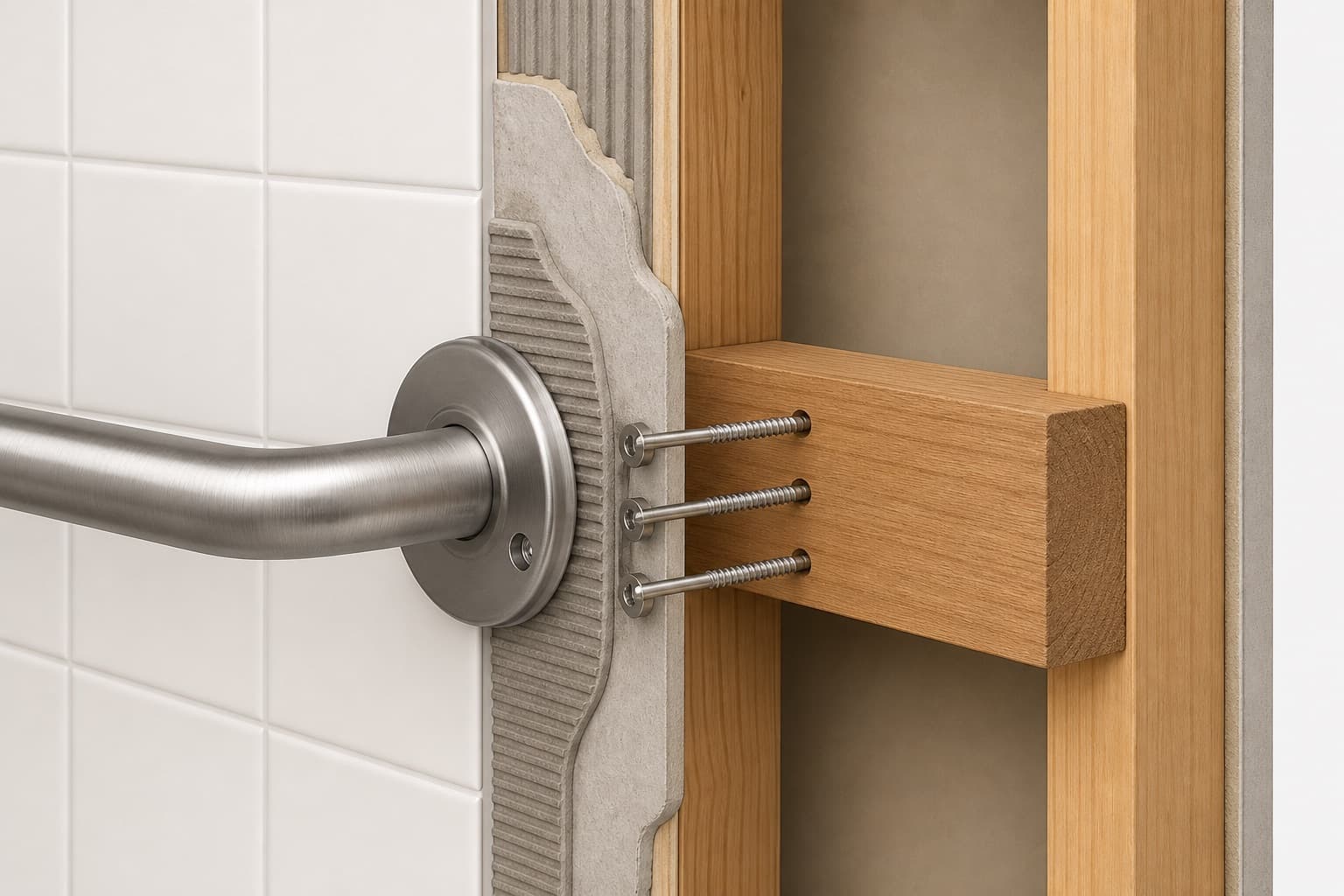
Behind the tile
The same visible bar can require very different work depending on the assembly behind it.
Often the most predictable scope when placement and the manufacturer’s attachment requirements align.
Can avoid opening the wall when the exact anchor, bar, substrate, thickness, and cavity conditions are compatible.
Requires confirmation of factory backers or an expressly approved mounting system; inspection may determine whether the job is feasible without reinforcement.
Blocking, drywall access, tile or wall repair, painting, and waterproofing restoration can cost more than the bar itself and should be quoted separately.
Product cost
The bar itself can be inexpensive or become a meaningful share of the project. Compare function and mounting requirements before finish alone.
Often $20–$150
A common national product-only range. Length, diameter, texture, finish, and hardware vary.
Can exceed $150
Premium finishes and coordinated residential styles can move above basic material ranges.
Product-dependent
Rated shelves, towel-bar combinations, and toilet-paper accessories can combine support and bathroom function.
Quote-dependent
Hinged toilet supports and large L-shaped systems have different hardware, leverage, clearances, and wall demands.
Illustrative scopes
These examples show why two quotes with the same bar count may not cover the same job.
Straightforward retrofit
Specialty surface
Complex wall condition
Local project factors
Bathrooms in Miami-Dade, Broward, and Palm Beach vary widely. The quote should reflect the actual property and wall—not just a county name.
Porcelain, marble, glass, and stone are common finish questions and may carry specialty-drilling charges.
Florida’s 2026 permit framework has exclusions. Palm Beach County currently says the new under-$7,500 exemption does not apply countywide.
Association, building-management, shared-wall, waterproofing, contractor-insurance, and landlord rules can affect timing and scope.
Corrosion-resistant materials and sealing that follows the product and waterproofing system matter in a humid, wet environment.
Possible assistance
Coverage and grant availability depend on the program, eligibility, authorization, and current funding. Confirm approval before ordering work.
| Program | What the research supports | Next step |
|---|---|---|
| Original Medicare | CMS lists grab bars as denied self-help devices rather than covered durable medical equipment. | Review the CMS coverage manual |
| Medicare Advantage | Some plans may offer plan-specific supplemental home-safety benefits. | Check the plan’s 2026 Evidence of Coverage and authorization rules. |
| Florida Medicaid LTC | Home Accessibility Adaptation can include bathroom grab bars for eligible members when authorized in the service plan. | Review Florida LTC services |
| VA HISA | May fund medically necessary improvements that facilitate use of essential bathroom or sanitary facilities for eligible Veterans. | Review VA HISA eligibility |
| Miami-Dade home-modification grant | The county program expressly includes grab bars for eligible homeowners and tenants age 62 and older; intake status can change. | Check the current county program |
Compare the same scope
A low headline price may omit the bar, hardware, surface work, reinforcement, or repair. Confirm that each provider is pricing the same installation.
Important: two bars in the same bathroom are not necessarily the same job if the surface, attachment method, product, and repair assumptions differ.
See Safe In Place contractor standardsFrom online estimate to a real scope
An accurate quote starts with the movement that needs support, the wall finish, what is behind it, and the proposed bar. Safe In Place can help clarify the situation and connect you with an appropriate local professional who can provide a site-specific quote.
Cost questions
Published 2026 guidance commonly places ordinary professional work in the low hundreds. One widely cited range is $100 to $350 per installed bar, while a May 2026 estimating model gives $158 to $398 per bar. The wall, bar, attachment method, and job minimum determine where a real quote falls.
A useful planning range for many standard professional installations is about $100 to $350 per bar. A single-bar visit can carry a larger share of the travel, assessment, layout, setup, and cleanup than an additional bar installed during the same appointment.
The first bar carries the provider’s minimum visit and setup work: travel, inspection, placement review, tools, drilling preparation, and cleanup. One current Palm Beach-area schedule illustrates this with $125 for the first ceramic-tile installation and $50 for each additional bar during the visit.
It can. Hard or brittle surfaces may require specialty drilling and more time. One current South Florida published schedule adds $40 per bar for porcelain, marble, or glass compared with ceramic, but that is one provider’s pricing structure rather than a universal surcharge.
Not automatically. A tested mounting system may be appropriate for a specific wall assembly without opening the wall. If no approved attachment works where support is needed, adding blocking, opening and repairing the wall, or changing the plan can materially increase cost.
National guides commonly place many standard products around $20 to $150, but premium decorative bars can exceed $150 and specialty or folding supports may cost substantially more. Confirm whether the quote includes the product, hardware, tax, and delivery.
Experience and legal scope both matter. The installer should understand placement, the exact wall assembly, specialty surfaces, approved mounting systems, and wet-area sealing. Florida license and permit questions depend on the project scope and jurisdiction rather than the job title alone.
Original Medicare generally does not cover grab bars; CMS lists them as denied self-help devices rather than durable medical equipment. Some Medicare Advantage plans may offer plan-specific home-safety supplemental benefits, so check the individual plan’s current Evidence of Coverage.
Florida Medicaid’s Long-Term Care program identifies bathroom grab bars as a possible Home Accessibility Adaptation for eligible members when authorized in the service plan. VA HISA may help eligible Veterans with medically necessary bathroom or sanitary-access improvements. Neither program is automatic.
Possibly. The answer depends on the address, property type, flood-hazard status, and work involved. Florida’s 2026 permit-exemption framework has exclusions, and Palm Beach County currently states that the under-$7,500 exemption does not apply countywide. Verify the proposed scope with the applicable authority.
Understand bar types, wall conditions, placement, standards, and installer questions.
Compare seats, handheld showers, flooring, toilet support, lighting, and access changes.
See how assessment, planning, and connection to appropriate local help fit together.
Local guidance
Review property conditions, the local permit path, and county resources that can change the next step.
Enter a 5-digit ZIP code to check availability.
Online figures help with planning. A real price depends on the bathroom, wall, bar, and mounting method. We’ll help you understand the next step.